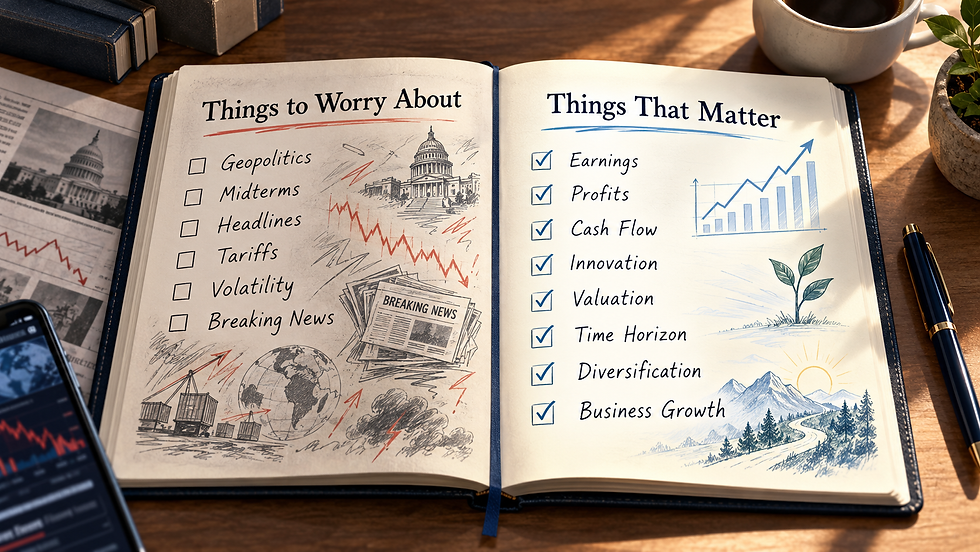
Common Advice When Markets are Falling is Misleading


You and your wife are counting down the days to your retirement in three months. The kids are coming in for the epic party, and you just splurged on business class tickets to Spain. Then the market’s mild correction turns into a stomach-turning free fall. Needing reassurance, you call me.
“Matt, are we still okay to retire? What should we do?”
I tell you to stay calm and stay the course. You thank me and hang up, then think about shifting those tickets to Economy.
When you relay my advice to your wife she is not convinced. She’s trying to maintain perspective, but the phone alerts are an unrelenting emotional assault predicting societal meltdown. Doing nothing sounds absurd.
“How does he know?” she asks. “What did he check?” Great questions.
The recent pullback in markets is tied to the AI theme, but you can find the case for doom everywhere. Inflation will spin out of control and the Dollar will collapse. The national debt will crush us. Cyber-attacks, mid-term results, and El Nino will bring the chaos. And there is the ultimate bear case, the inventors of AI suggesting an uncomfortably high probability that it will end humanity.
A further, more jarring correction is of course possible. If we see 50% stock market drawdown like we did in 2008, somebody in my profession is bound to tell you to do nothing. If that strikes you as a ridiculous, that’s because it is.
“Stay the course” and all the versions of that are a misleading oversimplification of what should be comprehensive risk management. It usually just means don’t sell all your stocks in a panic. That’s likely good advice, but not the only consideration on the table when things appear to be spinning out of control. Risk management demands preparation when things seem all clear, triggers choreographed moves when the storm is raging, and maybe even some improvisation in reaction to unexpected conditions.
Fear setting
Think back to September 2008. Try to remember it without knowing how it worked out. Lehman Brothers had just failed. Each day brought unthinkable headlines like money market funds “breaking the buck” and emergency government interventions.
It felt, at times, like the end of the world. It might feel that way this week or maybe we quickly recover, but certainly somewhere in the future is a week that will feel like an existential threat. Only this time you may have considerably more at stake. In 2008, perhaps you had twenty years of paychecks ahead of you and every two weeks your 401K contributions bought more stock. But if retirement is months or even a couple of years away, you’re counting on that account to send you a paycheck. Your experience as a buyer for 30 years of accumulation tells you little about your temperament as a seller in the distribution phase.
The Roman Stoic Seneca once wrote to a friend who was worried about losing a fortune in a lawsuit. Seneca suggested he assume for a moment that he’d already lost. What, exactly, would follow? Tim Ferriss popularized a modern version of this exercise called fear-setting. Give the worst outcome you reasonably fear a careful hearing. Work through what it would cost, what you could do to prevent or repair the damage, and whether you could live with what remains.
Let’s say the soon retiring couple has a $1 million portfolio and a $50,000 annual gap between their income and their spending. Now take 25% off the portfolio and give them three years with no recovery. They start retirement with $750,000. Three $50,000 withdrawals later, assuming no further gains or losses, they have $600,000. Could they live with that? Does one of them need to keep working? Would they have to sell the house? Or could they still retire this year if they postponed the kitchen remodel and spent a little less along the way?
Expectations of scenarios like that should have been built into the portfolio well before the bear market arrived. It’s fundamental to retirement planning safety to be prepared for that by having up to 8 or even 10 years of expected withdrawals in safer assets. It’s also likely the case that the stocks or other risky assets are diversified in holdings expected to recover and continue to grow. That’s when the advice not to sell is sound. That’s when the probability models and diversification strategy start to feel comforting rather than constricting.
When I am telling someone, they are OK, it is because we did the fear-setting scenario planning and can remain calm when the “expected” turbulence arrives. But even with that preparation, we are not going to do nothing. We can continue to play the risk management game as things develop. We won’t panic sell, but a change to expectations or altering spending plans are on the table. Not panicking is not “doing nothing,” it’s the result of what we already did.
Bear markets are expected, but bring unexpected circumstances
Market cycles can resemble natural cycles when seen over decades, appearing predictable and benign like the tide. But sharp price movements can reflect meaningful change with lasting impact. Markets falling because of spiking interest rates versus say a reaction to tariff policy out of Washington are legitimate reasons to reconsider the assumptions behind an investment that could lead to different buy/sell conclusions. You should expect changing circumstances will lead to changes in what assets you own.
Such changes happen more than you might expect. Suppose you bought an S&P 500 index fund in 2018 and have never sold a share. In December 2020, Tesla took the place of Apartment Investment and Management in the index. You went from owning a piece of an apartment company to owning a piece of an electric-car maker, partly because of the 2020 volatility. An active manager is revisiting projections as new evidence arrives. If you have outsourced stock picking to a fund manager, active or indexed, they will be doing their work in the background. That’s not panic selling, but it’s not strictly “staying the course” either.
Now what about that rental home you might own? The changing market conditions might demand you review that as well. Rents are dropping and hiring in your city has slowed. What actions do the new conditions suggest? It could prompt you to sell your place and redeploy the proceeds, but it might mean you consider buying more properties off desperate sellers at steep discounts.
That’s Bayesian updating. You start with a judgment and change your confidence in it according to the weight of the evidence. When markets are melting down there are changing circumstances that cause me to reconsider everything. There are newly developed risks and emerging opportunities coming on fast. Whoever has responsibility for managing assets (a fund manager, an advisor, or you) should be considering it all and weighing options. That’s not “doing nothing” even if it does not lead to immediate action.
What have we already decided?
If the current market conditions deteriorate further, I won’t be scrambling around looking for answers on what to do next. Before a client retires, I’d like them to know where the first $50,000 will come from, how they’ll fund the next two years if stocks stay down, and which spending they’ll revisit if the slump lasts longer.
Some decisions lend themselves to rules. You can automate a purchase every payday or rebalance when an allocation moves outside an agreed range. Those rules can apply to overarching portfolio decisions like rebalancing. For example, if US stocks move 20% it might trigger a rebalance. Rules based trading happens all the time in passively managed index funds and portfolio models. Those rules are meant to be studied actions that increase the probability of long term successful financial outcomes.
Enforcing those rules is reasonable thing to expect of a professional. Follow the prescribed known formula and best practices. Even if it is standard procedure, carrying it out requires discipline and thought. It’s not nothing.
Now let’s revisit that phone call. “Matt, are we still okay to retire?”
“Yes. We game-planned a more severe decline than this one when we finalized the allocation. You’ve got the first two years of withdrawals in cash and a bond coming due in year three. We agreed the kitchen could wait if markets stayed down. I’m comfortable leaving the funds alone. The number I’m less sure of is the rental income. The current tenant is there for a year, but as things develop lets rerun the assumptions.”
I suspect you’d feel better hanging up after that conversation. And when your wife asks how I know or what I checked, you’d have an answer.