
How to Stress Less About Headlines, Midterms, and Your Portfolio

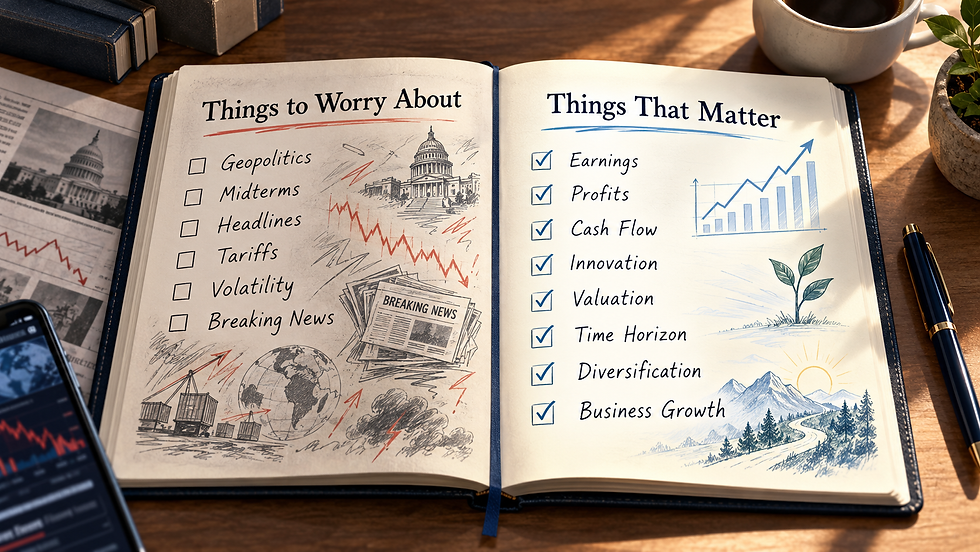
Last week, I attended an investment conference hosted by Franklin Templeton, an investment management firm with 80 years of history and $1.8 trillion of client assets in its care. We spent time with portfolio managers across public and private markets, digging into the depths and details of economic conditions, investment opportunities, and the risks that keep professional investors up at night.
But one of my favorite presentations came from Chris Galipeau, Head Market Strategist at the Franklin Templeton Institute, who delivered the opening remarks. With over 30 years of market experience and managing client money, his high-level view provided the most valuable perspective.
Sometimes a good chart can communicate more than a thousand words of commentary. Chris shared four that I thought were particularly worth passing along.
1. There's Always a Crisis
We are living through a particularly unsettling period of geopolitical conflict, political uncertainty, and economic disruption. Turn on the news, and there is no shortage of reasons to worry about what might happen next.
But consider this history of crises, from wars and assassinations to financial collapses and terrorist attacks.

Across these events, the stock market was higher 63% of the time three months later, 73% six months later, and 76% twelve months later.
Think about how frightening the Cuban Missile Crisis must have been in 1962. Yet the market was up 32% twelve months later. Or consider the invasion of Iraq in 2003, followed by a 27% market gain over the next year.
The magnitude of a crisis doesn't necessarily predict the magnitude of the market's response.
That's worth remembering the next time a headline makes you wonder whether you should be doing something with your portfolio.
2. Election Years Can Get Ugly. But Then What?
With another midterm election approaching, we can expect the usual parade of political predictions, policy speculation, and warnings about what an unfavorable election outcome could mean for investors.
And markets do have a history of volatility during midterm election years.
But look at what happens afterward.

Since 1950, the S&P 500 has experienced an average peak-to-trough decline of approximately 18% during midterm election years. Yet in every one of the 19 election cycles examined, the market was higher one year after its midterm-year low, with an average gain of approximately 32%.
That's a 100% historical hit rate. Of course, nobody knows where the market low will be until well after the fact, and past performance offers no guarantee of what happens next. If your investment horizon is measured in decades rather than months, the outcome of any single election probably deserves less attention than you're inclined to give it.
3. So What Really Drives Stock Prices?
If wars, elections, political upheaval, and the latest alarming headlines aren't reliable predictors of long-term stock market returns, what is?
Profits.
Over time, the value of publicly traded companies is closely connected to their ability to generate earnings. Consider this remarkable chart.

It compares the S&P 500 with corporate earnings over roughly 70 years. The long-term correlation between the two series is an extraordinary 0.95. Over shorter periods, stock prices can move dramatically because of interest rates, valuations, investor sentiment, and any number of unexpected developments.
But over decades, the trajectory of corporate earnings and the trajectory of stock prices have moved remarkably closely together.
It is a useful reminder of what we actually own when we invest in stocks. We're not buying political predictions or betting on tomorrow's headlines. We're buying ownership interests in businesses. Businesses that develop products, deliver services, compete for customers, improve productivity, and, hopefully, generate growing profits for their owners.
4. And How Do Profits Look Today?
Pretty good, actually. Despite all the geopolitical uncertainty, political division, and economic disruption, expectations for corporate earnings remain constructive.

Franklin Templeton's midyear estimates project particularly strong cumulative earnings growth over 2026 and 2027 in technology, materials, and energy. Technology leads with projected growth of approximately 100%, followed by materials at 54% and energy at 53%.
But perhaps the most encouraging aspect is the breadth of the forecast. All eleven S&P 500 sectors are expected to deliver positive cumulative earnings growth over the two-year period.
That's not a picture of an economy where businesses have stopped finding ways to grow.
Of course, these are forecasts, not guarantees. Earnings expectations can change, and strong earnings growth doesn't automatically produce equally strong investment returns. The price we pay for those earnings matters, too.
But there's an important distinction between a market rising purely on investor enthusiasm and one supported by businesses generating more profits. And right now, the earnings outlook offers investors legitimate reasons for optimism.
Keep Your Eye on the Business
Here's what I expect over the coming year. More geopolitical conflict and disruption. More election surprises and policy shifts. More periods of unsettling market volatility. And certainly more alarming headlines.
I also expect millions of businesses to keep doing what businesses do: innovating, competing, adapting, and working to generate more profits for their owners.
Some will succeed. Some will fail. Economic conditions will change, and markets will occasionally get carried away in both directions.
But these four charts reinforce an important distinction: What dominates the news is not necessarily what drives long-term investment returns.
Charts and research courtesy of Franklin Templeton Institute. Sources include FactSet, S&P Dow Jones Indices, Ned Davis Research, and Macrobond. Data and forecasts reflect the dates indicated on the original charts. Historical performance does not guarantee future results. Forward earnings estimates are subject to change.


